
On September 28, 2026, Avery Biomedical Devices is proud to celebrate the 12th Annual International CCHS Day. Click here for more information.
Congenital Central Hypoventilation Syndrome
Congenital Central
Hypoventilation Syndrome
In patients with CCHS, the brain fails to send proper signals to the phrenic nerve, which controls breathing. Without this signal, the body cannot maintain healthy oxygen and carbon dioxide levels—a condition that can be fatal in a short time. (Source: NORD)
The Avery Diaphragm Pacemaker provides a life-changing solution by directly stimulating the phrenic nerve. This stimulation causes the diaphragm to contract, allowing patients to take natural breaths.
Noah was born with CCHS and began pacing with the Avery Diaphragm Pacemaker 4 years ago. His family discovered the device through families in the CCHS family network, and then followed up with the CCHS experts at CHLA. The results have been life-changing.
Previously, he was tied to his ventilator 24/7. In order to do most activities that toddlers enjoy, his parents would backpack his vent on their backs so that he could participate in as much as possible, but it was challenging. Now, they say he can do “literally almost everything!” He’s a straight A student and paces all day at school, swims, golfs, plays basketball, and loves traveling to new places (the image here is Noah recently pacing on a trip to Hawaii!).
“Pacers have given Noah (and our family) the Freedom to live our best life! We’re so grateful!”

Diagnosis of CCHS must be done by a licensed physician, especially with the severe nature of the condition and requirements for care. Studies have shown CCHS to be the result of a mutation in a specific gene known as PHOX2B that encourages the formation of neurons (nerve cells) and manages how they form. While this mutation may be inherited, in the majority of cases the mutation occurs within the affected patient and is not inherited from a parent.
CCHS is characterized by adequate ventilation while the patient is awake and by hypoventilation with shallow breathing during sleep. More severely affected patients hyperventilate when both awake and asleep. This is caused by the brain not sending a signal to the phrenic nerves (the neurological pathways between the brain and each hemidiaphragm, originating at the C3-C5 vertebrae).
Find a Recommended Physician
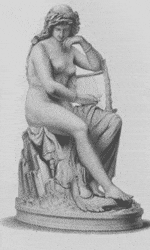
Ondine, a water nymph from German mythology, cursed her unfaithful husband “As long as you are awake, you shall have your breath, but should you ever fall asleep, then that breath will be taken from you and you will die!” From this ancient myth comes the name “Ondine’s Syndrome,” still used in certain parts of the world as a name for CCHS due to the difficulty of breathing during sleep.
How does the Avery Diaphragm Pacemaker compare to the competitor device for CCHS?